Skouta: official Swedish alerts in English people can act on
Skouta is a real-time iOS app that brings alerts from Swedish authorities to people who don’t speak Swedish. I built it with my cofounder at Fika Design Co.
01Where it started
I live and work in Sweden, and I don’t speak Swedish. The alerts I got from SOS 112, a widely used emergency app, came in Swedish only. I offered its developers my UX writing and translation help for free. They politely declined and added the idea to their list.
At a Lovable hackathon on International Women’s Day 2026, I used vibe coding to test what an English-friendly version could look like. The prototype grew from emergency alerts into an app that also covers weather, roadworks and other everyday disruptions.
About 1 in 5 people in Sweden were born abroad (Statistics Sweden, 2025), and official alerts are published in Swedish.
02The problem
Translating alerts was only the first step. Skouta also had to decide what deserves a person’s attention. It pulls from 8 official sources, and each one rates severity its own way: one uses a single level, others use three, four or five.
03My role
I wrote the key strings: category, severity, navigation and Profile labels, plus the AI disclaimer on every English alert. I own the DeepL glossary and the translation quality checks. My cofounder and I defined the categories, severity levels and filtering rules together. I defined Skouta’s content strategy. For longer copy in the app and on the website, I worked out first drafts with Claude, then reviewed and edited everything.
04Key decisions
Three severity levels
We chose critical, important and minor from the start, to keep the mental effort low without losing information. Mapping 1-, 3-, 4- and 5-level source scales onto those three took several rounds.
Severity levels at the source
1 level
- high
Treated as Critical.
3 levels
- very high
- high
- important
4 levels
- red / severe
- orange / significant
- yellow / moderate
- green / normal
For example, Trafikverket.
5 levels
- critical
- notice
transport notices: mapped to Minor first, then cut
In Skouta
3 levels
- Critical
- Important
- Minor
Cutting a tier of transport alerts
We first mapped transport “notice” alerts to minor. In practice they were high-volume and gave users nothing to act on. They also raised our translation costs and made Skouta look like a transport app. We dropped them, and transport alerts now reach users only when they’re important or critical. The trade-off is less transport coverage.
05Governing the AI translation
Rules we wrote filter every alert, assign its category and set its severity. AI enters at one step: DeepL translates each alert from Swedish to English. That step needed rules of its own.
I monitored translated alerts for several weeks, noting terms with the wrong tone or too much complexity, and translations that were confusing or overlapped. Those notes became a 28-term glossary that DeepL applies to every alert:
- US over UK English: lastbil becomes “truck,” inställd becomes “canceled”
- Everyday words over literal or archaic ones: framkomlighetsproblem becomes “traffic issues,” indragen hållplats becomes “stop closed”
- Swedish kept where people will see it: centrum becomes “centrum (center),” so a name like Lund Centrum still matches the signs and maps near the alert
| Swedish in the alert | English in Skouta |
|---|---|
| lastbil | truck |
| inställd | canceled |
| bärgare | tow truck |
| begränsad framkomlighet | reduced road access |
| framkomlighetsproblem | traffic issues |
| indragen hållplats | stop closed |
| omlagd körväg | route change |
| i höjd med | near |
| centrum | centrum (center) |
Every English alert names its source and says it was translated by AI, so people can check the original.
The Swedish version of the app went through native-speaker review too. Their notes on word-for-word phrasing are going into the next release.
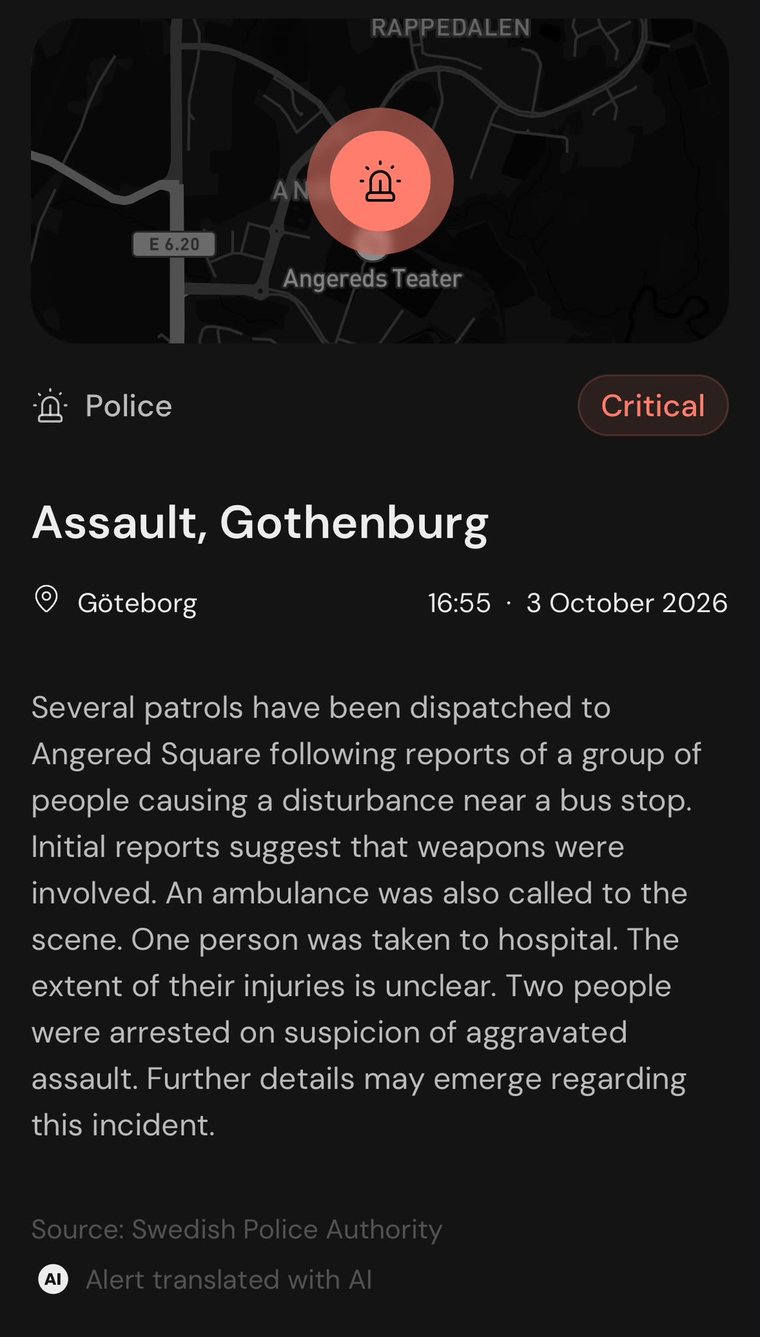
- Police
- The category label.
- Critical
- The severity label, one of 3.
- The alert text
- Translated from Swedish by DeepL, with the glossary applied.
- Source: Swedish Police Authority
- Every alert names its source.
- Alert translated with AI
- The note on every English alert.
06Outcome
Skouta went live on iOS on August 28, 2026. Before launch, it was named one of three finalists for the UX Nordic Award 2026 at Future Product Days. It’s too early for usage numbers that mean anything.
07Reflection
Skouta made me design both sides of one product: what users see, and the systems two people need to run it. Cutting transport notices was a content decision and a budget decision at the same time. I also defined Skouta’s content strategy, from the pillars we talk about to how each message serves both Swedish and non-Swedish speakers. Then I built that strategy into a weekly automated planning task that keeps the pillars in rotation.